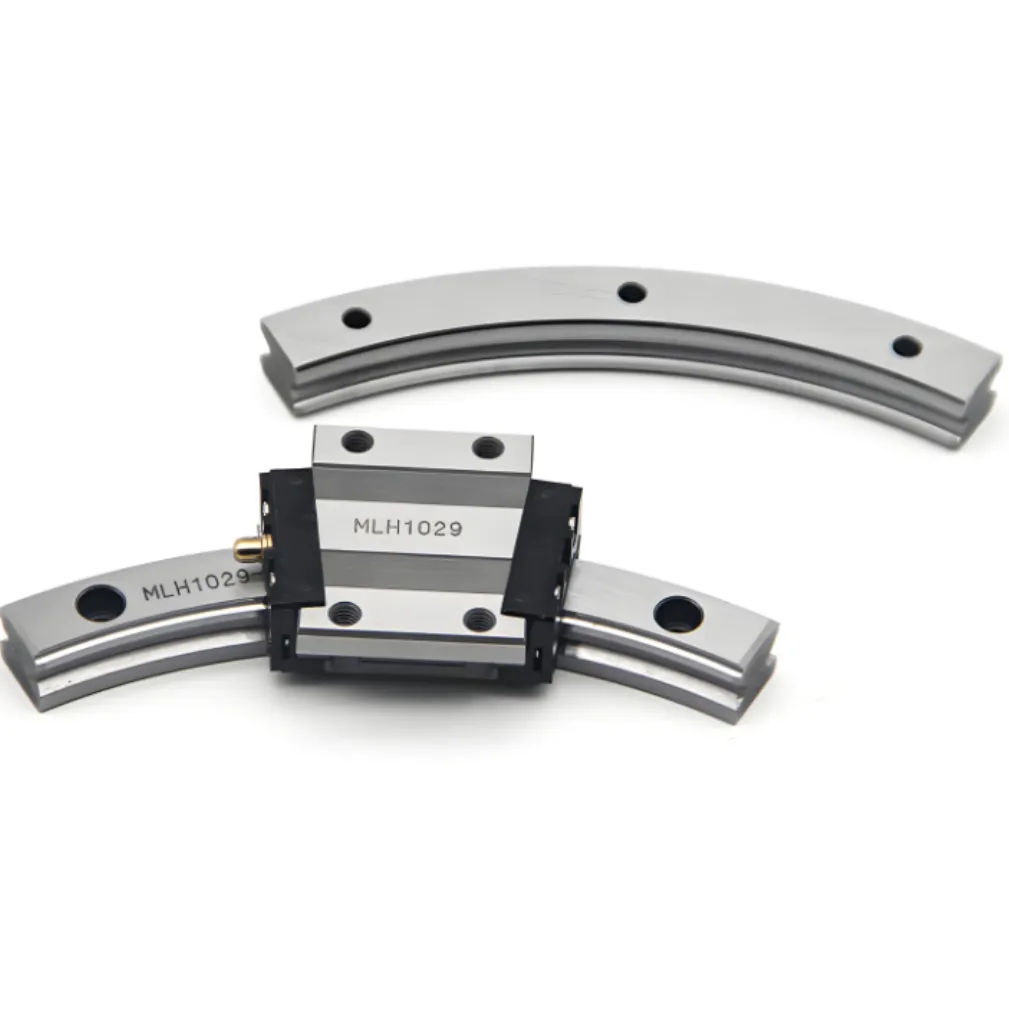
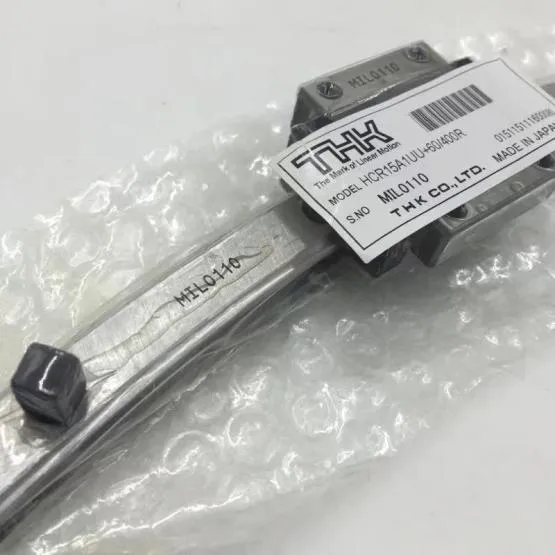
-
Product Features
High precision and stability
The HCR arc guide rail adopts a V-shaped guide rail surface design, and the contact surface between the roller and the guide rail is precision machined with high smoothness. The repeated positioning accuracy can reach ± 0.05mm, supporting seamless motion and suitable for high-precision scenarios. Its rigid structure can withstand large loads and impacts, and remains stable under high-speed motion.
Modularity and ease of maintenance
Adopting a detachable design, the guide rail and slider can be replaced separately, reducing maintenance costs. After the roller is damaged, only a new roller needs to be replaced and the eccentricity adjusted to restore operation, without the need for overall replacement.
Flexible adaptability
Supports incomplete circles (such as 90 °, 180 °) and multi segment splicing, which can be combined into 90-360 ° circular tracks to meet complex trajectory requirements. There are various installation methods that can be paired with drive systems such as chains, synchronous belts, servo motors, etc.
Low friction and efficient operation
The roller rolling friction design reduces resistance, improves movement efficiency, and has self-cleaning function, which can sweep away debris and adapt to harsh environments.
Material and process advantages
High quality bearing steel is selected and hardened to enhance wear resistance. Some models are made of stainless steel, suitable for corrosive environments such as the medical and food industries.
-
Product Application
Industrial automation: CNC machine tool path control, robot joint motion.
Precision equipment: medical surgical robots, semiconductor packaging lines.
Logistics system: Circular shelving conveyor, curved positioning of storage equipment.
-
Product Detail
-
-
Product Parameters

-
Designing High-Precision Arc Motion Systems with HCR Curved Linear Rails and Customized Bearings
In modern industrial applications, precision and flexibility in motion systems are crucial for achieving efficiency, accuracy, and reliability. HCR Curved Linear Rail Systems, including models HCR45A+60/1000R and HCR45A+60/1200R, provide advanced solutions for high-precision arc motion in CNC machines, robotic systems, and automated production lines. By combining robust construction, customizable radii, and smooth bearing systems, HCR curved linear guides enable engineers to design motion systems that meet complex operational demands.
1. The Importance of Arc Motion in Industrial Systems
Traditional linear guides are designed for straight-line movement, which can limit the flexibility of a machine’s design. In contrast, curved linear rails allow components to follow circular or arc paths, enabling compact layouts, efficient use of space, and improved workflow in automated production lines. CNC routers, robotic arms, and inspection systems benefit from the smooth, precise arc motion offered by HCR curved guides, ensuring that machines can execute intricate operations with consistent accuracy.
2. Precision Engineering of HCR Curved Linear Rails
The precision of HCR45A+60/1000R and HCR45A+60/1200R is achieved through several engineering innovations:
Hardened steel rails and bearing blocks: Provide wear resistance and maintain smooth motion over long operational periods.
Recirculating ball bearings: Ensure low-friction, highly repeatable motion, reducing vibration and backlash.
Customizable radius: The different radius options allow engineers to select the ideal curve for their specific machine layout, maintaining accuracy in both tight and extended arcs.
These features make HCR curved linear rails particularly suitable for high-precision applications where every millimeter of motion matters.
3. Applications in CNC Machines
CNC machines often require tools to move along curved or circular paths for contouring, engraving, or milling. Using HCR curved linear guides, engineers can design CNC machines that maintain consistent feed rates along complex trajectories. The smooth motion of HCR45A curved rails minimizes vibration, improves surface finish quality, and enhances dimensional accuracy. The HCR45A+60/1000R is ideal for smaller machines requiring tighter arcs, while HCR45A+60/1200R supports larger machines with extended curved travel, maintaining stability and precision under heavier loads.
4. Applications in Robotics
Robotic systems benefit greatly from HCR curved linear guides in applications such as pick-and-place, assembly, and material handling. The guides allow robotic components to move along precise arcs without the complexity of additional rotary joints. Advantages include:
High-speed, smooth motion for efficient operation.
Accurate repeatability for repetitive tasks.
Compact design, enabling better workspace utilization.
Smaller robots often use HCR45A+60/1000R for high-precision tasks, while industrial robots with larger payloads and longer travel distances rely on HCR45A+60/1200R.
5. Integration and Maintenance
HCR curved linear rails are easy to integrate into machine frames thanks to flanged mounting and pre-engineered radius specifications. Stainless steel construction and sealed bearing blocks reduce the risk of contamination, while routine lubrication ensures long-term performance. Proper integration ensures machines operate efficiently and maintain high precision over their service life.
6. Advantages Over Traditional Systems
Compared to straight linear rails or complex rotary mechanisms, HCR curved guides provide:
Simplified machine design with fewer mechanical components.
High accuracy in arc motion with minimal backlash.
Smooth, low-friction operation even under high-speed and high-load conditions.
Reduced maintenance requirements and extended service life.
These benefits make HCR curved rails the preferred choice for engineers designing high-precision arc motion systems in modern industrial environments.
Conclusion
HCR Curved Linear Rail Systems, including HCR45A+60/1000R and HCR45A+60/1200R, deliver high-precision, durable, and smooth arc motion solutions for CNC machines, robotics, and automated production lines. By combining customizable radii, robust construction, and advanced bearing systems, they enable engineers to design efficient, accurate, and reliable motion systems capable of meeting the demands of modern industry.
-
Enhancing Industrial Automation with HCR Curved Linear Guide Systems: Smooth ARC Motion for CNC and Robotics Applications
Industrial automation increasingly requires machines that can perform precise movements along curved paths. HCR Curved Linear Guide Systems, including HCR45A+60/1000R and HCR45A+60/1200R, provide innovative solutions for smooth ARC motion in CNC machines, robotic systems, and automated production environments. These systems combine customizable radii, precision bearings, and robust rails to improve productivity, efficiency, and accuracy in complex industrial applications.
1. The Role of Curved Linear Guides in Automation
Automation systems benefit from curved motion because it allows for more compact layouts, reduced mechanical complexity, and improved operational flexibility. Straight-line guides often require additional rotary joints to achieve circular motion, increasing the number of components and potential points of failure. In contrast, HCR curved linear guides enable components to follow smooth arcs directly, reducing mechanical complexity while maintaining precision.
2. Features of HCR Curved Linear Guides
The HCR45A+60/1000R and HCR45A+60/1200R systems offer several key features:
Precision-ground rails and bearing blocks: Provide consistent, smooth motion along curved paths.
Recirculating ball bearings: Ensure low-friction, repeatable motion for high-speed applications.
Customizable radius: Allows engineers to select the optimal arc radius for each machine, ensuring accurate movement along complex paths.
Durable construction: Stainless steel rails and sealed bearings reduce wear and maintenance requirements.
These features enable HCR curved guides to deliver high precision in applications that require continuous or repetitive motion along arcs.
3. CNC Applications
In CNC machining, tools must often follow curved or circular trajectories for cutting, milling, or engraving. HCR curved linear rails provide smooth, repeatable motion for tool heads, improving machining accuracy, reducing vibration, and ensuring high-quality surface finishes. The 1000R radius is suitable for compact machines, while the 1200R radius accommodates larger CNC machines requiring longer arc travel.
4. Robotics Applications
Robotic arms and automated handling systems require precise arc motion for pick-and-place, assembly, and inspection operations. HCR curved linear guides support:
High-speed movements with minimal vibration.
Accurate positioning and repeatability for repetitive tasks.
Compact design, allowing for efficient use of workspace.
Smaller robots benefit from HCR45A+60/1000R, while larger industrial robots use HCR45A+60/1200R to manage heavier payloads and extended motion paths.
5. Integration into Automated Systems
HCR curved linear rails are designed for easy integration into automation systems. Pre-engineered radii simplify machine design, and flanged mounting options allow secure attachment to frames. Sealed bearing blocks minimize contamination, and routine lubrication ensures long-term performance. Integrating these rails reduces mechanical complexity, improves reliability, and enhances the precision of automated systems.
6. Advantages Over Conventional Motion Systems
Compared to traditional linear guides or rotary mechanisms, HCR curved guides offer:
Simplified design with fewer moving parts.
Smooth, low-friction motion along arcs.
Reduced maintenance and increased lifespan.
High precision and repeatability even in high-speed applications.
These advantages make HCR curved linear systems a preferred choice for engineers seeking efficient, reliable, and precise arc motion solutions.
7. Enhancing Productivity and Efficiency
By implementing HCR curved linear guides in CNC and robotic systems, manufacturers can:
Reduce cycle times due to smoother motion.
Increase production throughput.
Maintain higher machining and assembly accuracy.
Reduce downtime and maintenance costs.
The combination of customizable arc radii and advanced bearing technology ensures that industrial machines perform at optimal efficiency.
Conclusion
HCR Curved Linear Guide Systems, including HCR45A+60/1000R and HCR45A+60/1200R, provide smooth, precise, and durable arc motion solutions for CNC machines, robotics, and automated production lines. With customizable radii, advanced bearing systems, and robust construction, HCR curved rails enable engineers to design high-performance, efficient, and reliable automation systems that meet the demanding needs of modern industry.
-
What is the average lead time?
Request a Quote
If you are interested in our products, you can choose to leave your information here, and we will be in touch with you shortly.